Why Kids Need to Build Before They Code
2025-12-09
Why Kids Need to Build Before They Code
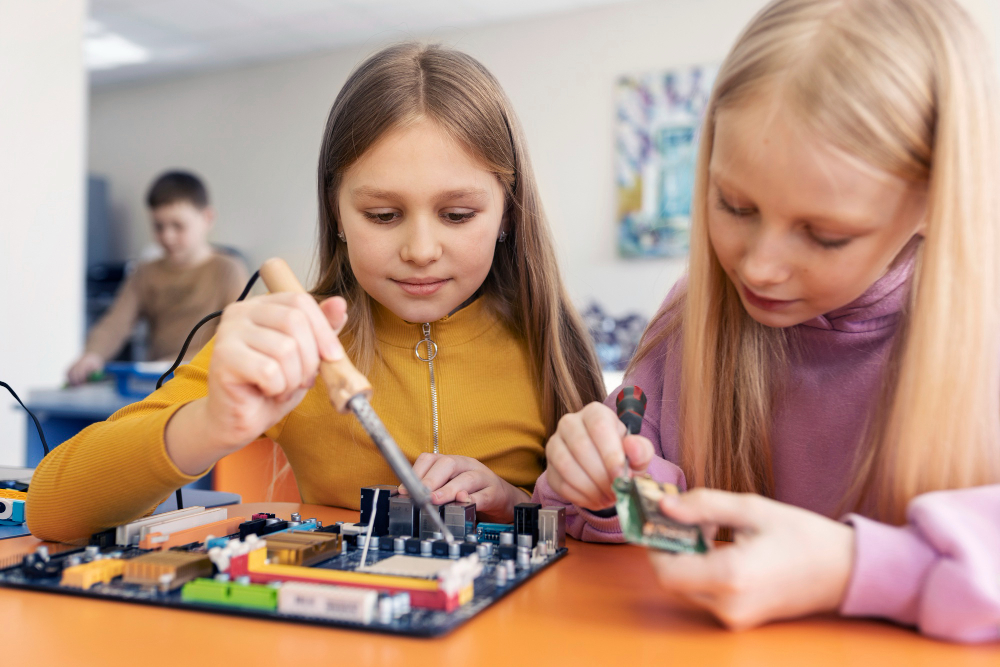
Before the Keyboard Comes the Workshop
Today, coding is often treated as the starting point for STEM learning. Kids are introduced to Scratch, Python, and robotics software earlier than ever, sometimes before they’ve ever taken apart a toy or wired a simple circuit.
But here’s the truth: great coders aren’t created by screens alone.
The strongest foundation for coding doesn’t begin with syntax or commands. It begins with physical tinkering, building, breaking, testing, and fixing real objects. Before kids can reason abstractly in code, they need hands-on experiences that make logic, cause-and-effect, and systems real.
How Building Strengthens the Coding Mindset
When kids build with their hands, they aren’t just playing, they’re developing the mental muscles that coding depends on.
Physical projects teach:
- Cause and effect: if something doesn’t work, there’s a concrete reason
- Logical sequencing: parts must connect in the right order
- Persistence: solutions take multiple attempts
- Systems thinking: one change affects the whole structure
These lessons become intuitive long before a child ever writes an if statement.
Real Logic Comes From Real Feedback
In coding, errors can feel abstract and frustrating. A program fails, but it’s not always obvious why. Physical building removes that mystery.
If a circuit doesn’t light up, kids can trace the wires. If a structure collapses, they can see exactly where it failed. If a robot moves the wrong way, they can flip a connection and test again.
This visible, immediate feedback trains kids to debug naturally, a skill that transfers directly to coding later on.
Failure Feels Safer in the Physical World
Building teaches kids that failure isn’t personal, it’s informative.
When a tower falls or a motor stalls, kids don’t see a red error message. They see a design problem they can fix right away. That mindset shift is critical. It turns frustration into curiosity and builds confidence through iteration.
By the time kids start coding, they’re already comfortable with trial, error, and improvement, the heart of programming.
Physical Builds Create Mental Models for Code
Hands-on projects help kids form mental models that make abstract coding concepts easier to understand later:
- A switch controlling a circuit mirrors if/then logic
- A crank that repeats motion introduces loops
- A lever optimizing effort reflects efficient algorithms
- A connected system of parts demonstrates functions working together
Coding stops feeling like magic when kids can connect it to something they’ve already built and tested with their hands.
How Parents and Teachers Can Start Today
You don’t need advanced tools to prioritize building first:
-
Offer open-ended materials Cardboard, tape, string, blocks, and recycled parts encourage creativity over instructions.
-
Focus on simple machines and circuits Levers, pulleys, ramps, LEDs, and motors build intuition fast.
-
Delay perfection Let kids build quickly, test early, and improve often.
-
Ask guiding questions instead of fixing “Where do you think it stopped working?” “What could you change to make it stronger?”
These small shifts create confident problem-solvers long before formal coding begins.
Build First, Code Better
Teaching kids to build before they code isn’t about slowing them down, it’s about setting them up for long-term success.
When kids understand how ideas turn into real outcomes, coding becomes a powerful extension of skills they already trust. They approach screens with confidence, logic, and creativity, not fear.
Clubhouse Engineers: Empowering Young Innovators
We are a STEM enrichment center in the Greater Toronto Area for curious minds aged 9 to 17. Our hands-on programs in robotics, coding, and electronics are designed to spark creativity, encourage teamwork, and build lasting confidence.
Ready to bring fun, hands-on STEM to your students? Explore our programs at https://clubhouse.engineer